.png?width=96&height=41&name=Cove_Logo_Updated%20(1).png "Cove_Logo_Updated (1)")
.png)
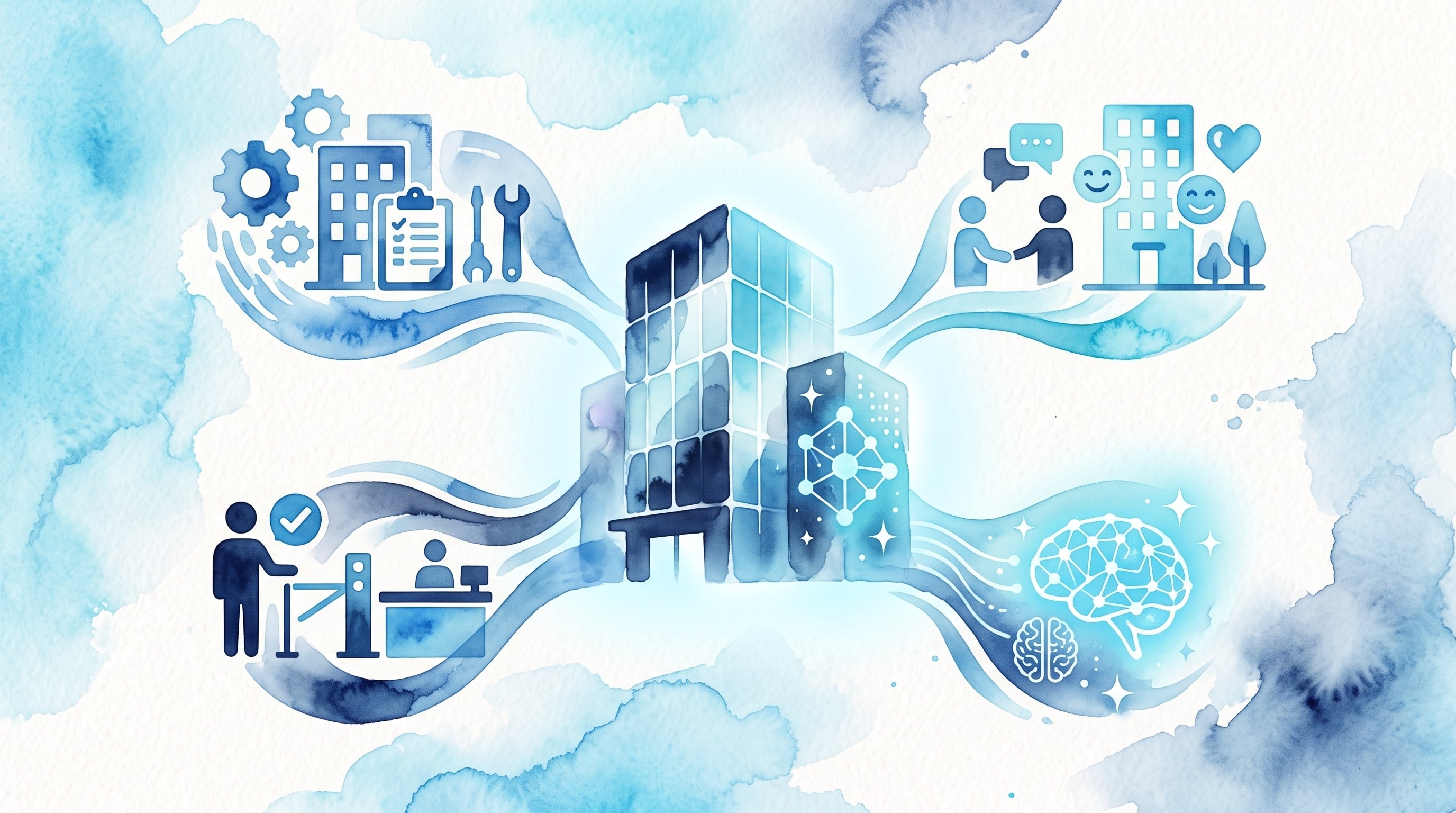
Your tenants never think about your software. They think about whether the lobby door let them in on the first tap, whether the heat complaint they filed on Monday got fixed by Tuesday, and whether the guest they invited for a noon meeting made it upstairs without standing at a confused front desk. Every one of those moments is shaped by the systems running behind the scenes, and your tenants feel the result long before they could ever name the cause.
That matters more than it used to. CBRE has described a flight to quality, with many tenants willing to pay a premium for top-tier buildings while landlords of the best-run properties gain leverage as quality space gets scarcer. Quality now means more than marble and a rooftop terrace. It shows in how the building actually performs day to day, and that performance is what tenant experience really measures. When the experience is smooth, tenants renew. When it stutters, they start taking competitors' calls.
Here's the catch most teams run into. The experience you deliver gets split across a pile of disconnected tools, and the seams between those tools are exactly where tenants get let down. Let’s dive into how commercial property management platforms fix that by pulling communication, operations, access, and service into one connected system, and why that consolidation does more for tenant satisfaction than any single new amenity you could bolt on.
Tenant Experience Is Now the Deciding Factor
For a long time, location and rent did most of the work of keeping a building leased. Those still matter, but they've been joined by something harder to put on a spec sheet: how it feels to occupy the space every day. Employees who can choose where they work judge a building by whether it helps them or gets in their way, and the companies signing the leases are paying close attention to that judgment. A building that runs well makes its tenants look good to their own people, and that's a powerful reason to stay.
This is why tenant experience has moved from a marketing phrase to an operational priority. It covers the whole arc of occupying your building, from the morning badge-in to the after-hours service call, and every touchpoint either builds goodwill or chips away at it. The flight to quality CBRE points to rewards the buildings that get these details right, because a smooth experience is the clearest signal a tenant has that their landlord is paying attention. Get it right and you protect your renewals. Let it slide and you hand your competition an opening.
Every Disconnected Tool Adds a Seam Tenants Feel
Walk through a typical building's setup and you'll usually find a separate tool for each job. One app handles door access, another logs visitors, service requests come in through an email inbox, announcements go out by a different channel, and room or amenity bookings live somewhere else entirely. Each tool might work fine on its own. The trouble is that your tenants don't experience them one at a time. They experience the gaps between them.
Those gaps turn into friction fast. A tenant downloads one app for the gym and a different one to let in a guest, then gives up and calls the front desk anyway. A maintenance request sits in an inbox over the weekend because no one owns it. Your property management software for accounting can't see the service history, so you walk into a renewal meeting without the full story of how well you served that tenant all year. None of these failures is dramatic, and that's the problem. They're small, constant, and they quietly add up to a tenant who feels like the building is working against them.
What Unified Property Management Actually Means
Unified property management means the tools that run your building share one foundation instead of operating as separate islands. Communication, operations, access, and service all live in the same system, so information flows between them without anyone rekeying it or chasing it across platforms. When a tenant submits a request, your engineers see it, the manager can track it, and the record stays attached to that tenant and that space for good. One login for the tenant, one source of truth for your team.
The payoff shows up in how problems get handled. With everything connected, an access issue, a work order, and a tenant message about the same broken door are obviously parts of one event, so your team responds once and completely. Commercial property management platforms are built around this idea, and the building operations and tenant experience sides of the system talk to each other by design. That connection is what turns a stack of decent tools into a single experience your tenants can actually feel.
Communication That Lands the First Time
Most tenant frustration starts with a message that never arrived or an answer that never came. An elevator goes out of service and half the building finds out by getting stuck in the lobby. A planned water shutoff surprises a lab that needed an hour's notice. When announcements and requests run through scattered channels, things fall through, and every dropped message tells your tenant that you're hard to reach.
A connected platform gives you one reliable channel in both directions. You can push a building-wide notice and know it reached every tenant, and they can reach you without guessing which app or inbox to use. Because the conversation lives in the same system as your operations, a tenant's message about a cold conference room can become a tracked work order in a click, with the tenant kept in the loop as it moves. Clear, fast, two-way communication is one of the simplest ways to raise tenant satisfaction, and it costs you nothing but the decision to stop scattering it.

Service Requests That Close the Loop
Think about what a tenant actually wants when they report a problem. They want to know you received it, that someone owns it, and that it's getting handled. A request that disappears into an inbox delivers none of that, and the silence is what damages the relationship even more than the original issue. The fix is a workflow that closes the loop from the first report to the final confirmation.
When service runs on a connected system for your property managers, every request gets logged, routed to the right engineer, tracked to completion, and confirmed back to the tenant automatically. Nothing slips, and you build a full service history for each tenant without anyone keeping notes by hand. That history pays off twice. It helps you respond faster the next time, and it gives you proof of how well you've served a tenant when the renewal conversation comes around. There's a direct link between how well you run a building and how tenants feel about staying, and a closed-loop service process is where that link gets built.
Access and Security Without the Friction
Access is where a tenant's day begins, so it sets the tone for everything that follows. A mobile credential that works on the first tap, a guest who gets a pass before they arrive, a contractor who's cleared for the right floor at the right time: these small wins make a building feel effortless. When access lives in its own silo, though, it creates daily snags, like a new hire who waits three days for a badge or a visitor who's stuck in the lobby because the host never got the alert.
Folding access and visitor management into the same platform removes that friction and tightens security at the same time. Your team grants and revokes credentials from the same place they manage everything else, visitor pre-registration ties straight into tenant communication, and you keep a clean record of who entered the building and when. Security and convenience usually feel like a trade-off, and a unified system is how you stop choosing between them. Tenants get a building that's easy to move through, and you get control you can actually audit.
The Payoff Is Satisfaction You Can Measure
Pulling your tools together does more than smooth out daily friction. It finally lets you see the experience clearly. When communication, service, and access data sit in one place, you can measure what used to be invisible: how fast you close requests, which issues keep coming back, which buildings in your portfolio run hot. The right commercial real estate technology turns that scattered activity into a picture you can act on, and analytics built on your own operations data point you straight at what to fix first.
That visibility changes the renewal conversation. Instead of walking in with a gut feeling, you walk in with a record: response times, resolved issues, a year of reliable service you can point to. Tenant satisfaction stops being a hope and becomes a number you manage, and the moves that improve it become obvious. This is the quiet advantage that good commercial property management platforms give you. They protect the relationships that drive your income, and they do it with a system that keeps proving its own value every time a tenant's day goes smoothly.
Where to Start
You don't have to rip everything out at once to make progress. Start by mapping the tools your tenants actually touch and counting the logins and handoffs between them. That map almost always reveals one or two seams causing most of your complaints, like service requests with no owner or access that lags behind move-ins. Fixing the worst seam first gives you a fast, visible win and buys you room to plan the rest.
From there, move toward consolidation on purpose. Look for commercial property management software that connects communication, operations, access, and service rather than adding yet another standalone app to the pile, and bring your highest-traffic buildings onto it first. Tell your tenants what's changing and why, since a single app and a faster response are easy improvements to appreciate. Each system you fold in removes a seam, and every seam you remove is one less small reason for a good tenant to leave.

FAQ Recap
What are commercial property management platforms?
Commercial property management platforms are unified systems that run the core functions of a building, including communication, operations, access, and service requests, from one connected place. Instead of stitching together separate apps for each task, you manage everything on a shared foundation where information flows automatically between functions. That connection is what lets a property team deliver a consistent experience and keep one reliable record for every tenant and space.
How does a unified platform improve tenant experience?
A unified platform improves tenant experience by removing the gaps between disconnected tools, which is where most daily frustration lives. When access, communication, and service all share one system, a tenant gets one login, faster responses, and the confidence that nothing they report will fall through. The result feels less like using software and more like a building that simply works, which is exactly what drives renewals.
Is unified property management worth it for a smaller portfolio?
Yes, because the friction of disconnected tools hits small portfolios just as hard as large ones, and often with leaner teams to absorb it. Consolidating onto one platform cuts the manual handoffs that eat your staff's time and gives even a small operation the response speed and service record that tenants notice. You don't need hundreds of buildings to feel the payoff of fewer systems and cleaner data.
How does tenant experience affect retention?
Tenant experience is one of the strongest predictors of retention, because tenants renew in buildings that make their working lives easier. A flight to quality has tenants paying a premium for properties that run well, so a smooth, responsive experience directly protects your occupancy and your rents. Every dropped message or slow repair, by contrast, gives a tenant a reason to listen when a competitor calls.
What's the difference between property management software
and a unified platform?
Standalone property management software usually handles one job well, such as accounting, work orders, or access, while a unified platform connects those jobs into a single system. The difference shows up in the gaps: separate tools leave seams your tenants feel, while a connected platform passes information between functions so nothing gets lost. For tenant experience, that connection is the whole point, because the experience is only as smooth as the handoffs behind it.

.jpeg)
.jpeg)
.jpeg)