.png?width=96&height=41&name=Cove_Logo_Updated%20(1).png "Cove_Logo_Updated (1)")
.png)
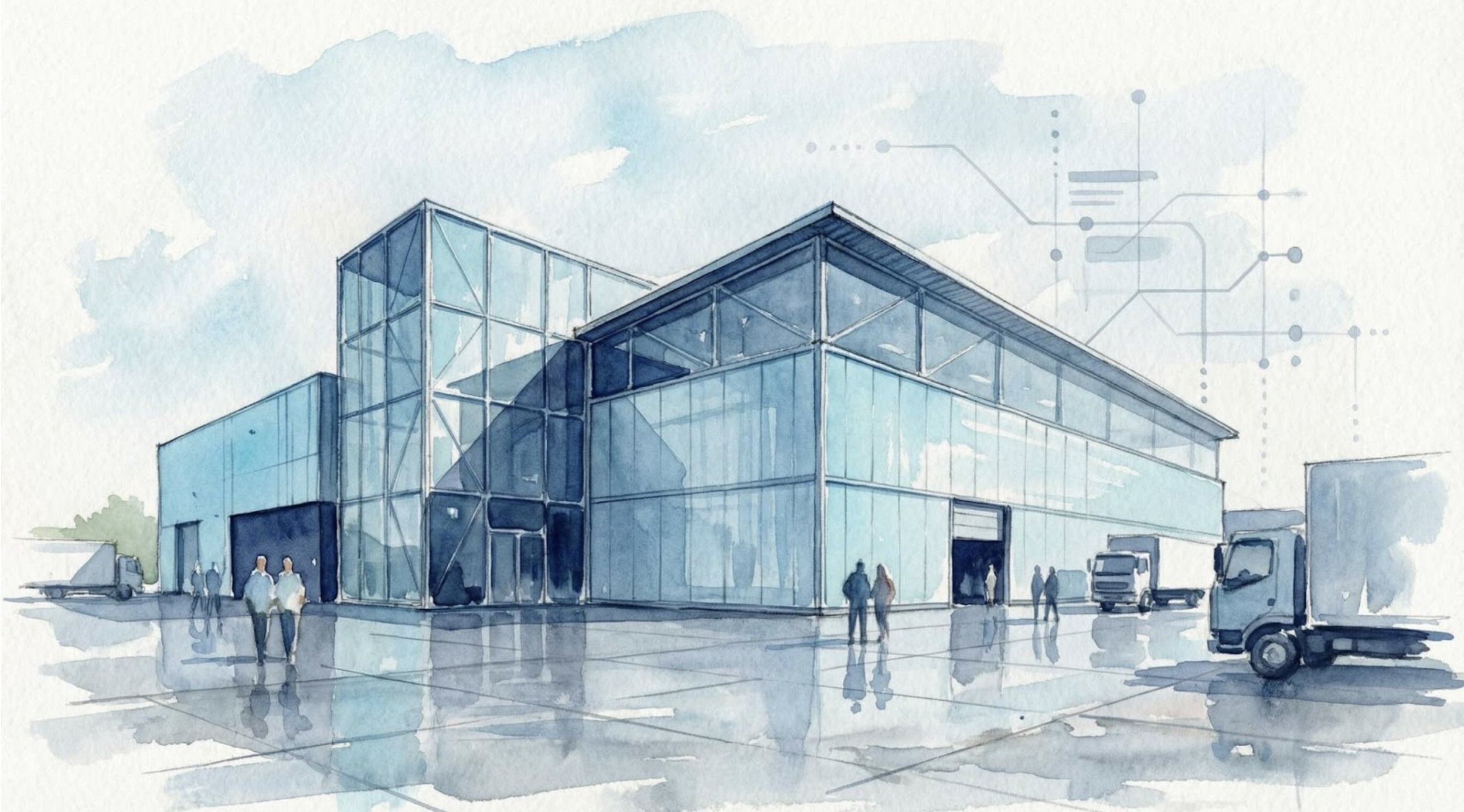
If you run industrial buildings, you already know the work is fast, physical, and full of moving parts. People come and go all day. Drivers. Contractors. Inspectors. Vendors. Temps. Sometimes customers. Sometimes a tenant’s guest who “will only be here a minute.” The site can feel controlled until the moment it is not.
That gap between “feels controlled” and “is controlled” often comes down to one thing: whether you can answer a simple question right now. Who is onsite, where are they, and why are they here. When you cannot answer, the costs show up in places you do not expect.
The Blind Spot that Hides Behind Normal Activity
Industrial properties are built for flow. Material flows. Equipment flows. People flow. Most days, that is a strength. It is also how small access problems stay invisible for a long time. A side door that does not latch. A driver who walks in through the wrong entrance. A contractor who bypasses check in because “they come here every week.” Those moments blend into the day.
The reason this matters is simple. Your building is a place where goods are stored and handled, often with added services like packaging, labeling, and order fulfillment. That combination creates constant movement, plus a real need to keep goods secure.
This is also a higher risk environment than many people realize. In 2024, warehousing and storage had a total recordable injury and illness rate of 4.8 cases per 100 full time workers, while private industry overall was 2.3. That means the injury rate in warehousing was about double the private industry average. When the environment is that active, “unknown people onsite” becomes more than a security issue. It becomes a safety and operations issue.
Safety and Emergency Response Depend on a
Real Roster
In a real emergency, you need to know who must get out, who might need help, and whether anyone is missing. The Occupational Safety and Health Administration requires emergency action plans to include procedures to account for employees after an evacuation. That requirement points to a basic truth. If you cannot account for your own people, everything slows down.
Most industrial sites also have nonemployees onsite. Drivers waiting at a dock. A refrigeration vendor in the yard. A cleaning crew in a back corridor. That is why OSHA’s own emergency planning guidance calls out the need to account for nonemployees, along with steps like designating assembly areas and taking a head count so you can identify who is missing and where they were last seen.
If you do not have a reliable check in and check out process, you end up guessing during the worst moments. Guessing creates two bad outcomes. You might miss someone who needs help. Or you might launch an unnecessary search that puts responders at risk in an unstable building. OSHA warns that confusion at assembly areas can cause delays in rescue and lead to dangerous search and rescue operations.
A practical way to tighten this up is to treat your onsite roster as part of your emergency plan, not a separate admin task. You want one clear process that supports safety drills, real incidents, and normal daily work. Start with three simple moves: choose a single primary check in point for people on foot, define a separate process for vehicle entry, and name a person on each shift who owns the “who is onsite” list during emergencies.
Security and Theft Risks are Rising Around the
Building Perimeter
If you store anything valuable, you already think about theft. What has changed is how organized and frequent some theft has become, especially around freight. Verisk CargoNet reported 3,625 cargo theft incidents across the United States and Canada in 2024, a 27 percent increase from 2023. It also reported an estimated average value per theft of $202,364. National Insurance Crime Bureau has warned that cargo theft losses increased by 27 percent in 2024, with further increases projected.
Those numbers matter to you even if you are not the shipper. Your site can still be the place where the theft happens. A yard is not just outdoor space. A dock door is not just a door. These are high value access points where someone can blend in if your process is loose. When you do not know who is onsite, you also do not know who is pretending to be allowed onsite.
There is another angle that gets less attention: violence and personal safety. In 2024, warehousing and storage recorded 32 fatal occupational injuries, including 10 related to violent acts. You cannot prevent every threat, but you can reduce opportunity. Knowing who is onsite, and limiting where they can go, is part of reducing opportunity.
Action here does not require turning your building into a fortress. It requires tightening identity and purpose at the points where strangers become “allowed people.” You can do that by using a visitor management system for vendors and contractors, requiring a named host, and matching the visitor to a specific work order, delivery number, or scheduled task. When a person cannot tie themselves to a clear purpose, you treat that as a stop point, not a customer service moment.
Compliance and Liability Follow the People Onsite
Even when your intent is good, investigations and claims often come down to what you can prove. Who was onsite. Who approved the work. Who had access. Who was trained. Who was escorted. The record is what turns confusion into clarity.
This is where many teams get surprised. OSHA’s multi employer citation policy says that on multi employer worksites, more than one employer may be citable for a hazardous condition, and it uses categories like creating, exposing, correcting, and controlling employers. If your site regularly hosts outside employers, you cannot assume safety responsibility stays neatly separated by badge color or contract language. What you control, what you allow, and what you fail to monitor can matter.
Good access records also support basic internal learning. The U.S. Environmental Protection Agency has a clear example of what “visitor access records” look like in practice. In its physical and environmental protection procedure, it calls for maintaining visitor access records, reviewing them in response to an information or physical security incident, and reporting anomalies. It also notes that visitor records can be maintained with automated mechanisms or paper based systems when needed.
You also need to balance security with privacy. The same EPA document includes a privacy focused control to limit personally identifiable information in visitor access records to specific elements identified in a privacy risk assessment.] That is a useful model for industrial properties too. Collect what you need for safety, accountability, and investigations. Do not collect extra data just because you can.
A strong, simple approach is to define a “minimum necessary” visitor record. Name, company, reason for visit, who they are meeting, entry time, exit time, and where they are allowed to be. Then set a retention period that matches your risk and any local requirements, and make sure the records are protected.
Build a Visitor Management System that Does
Not Slow the Site Down
The biggest fear with tracking people onsite is that it will clog operations. That fear is valid if the process is designed like a corporate lobby. Industrial sites have different rhythms. What works is a system built around perimeters and zones.
The Cybersecurity and Infrastructure Security Agency describes layered security as a security in depth approach, with outer, middle, and inner perimeters. It frames this as a way to slow or discourage unauthorized access. You can use that idea to design a practical onsite tracking process that matches how your property actually works.
Start by mapping your perimeters in plain language.
Outer perimeter is the edge of the property, including gates, parking, and vehicle entrances. Middle perimeter is the yard, dock apron, and exterior doors. Inner perimeter is inside the building, especially areas with equipment, inventory, or sensitive processes. Once you have that map, you decide where identity must be verified, where badges must be visible, and which zones require an escort.
Then build your process around visitor types. Drivers are not the same as a mechanical contractor. A fire inspector is not the same as a catering delivery. Give each type a simple lane: where they arrive, how they check in, what they wear, and where they can go. The CISA planning workbook prompts teams to define visitor access practices and visitor screening protocols, and to think about how first responders gain access during emergencies. Those prompts apply well to industrial properties even though they are written broadly.
If you want a system you can run with limited staff, focus on five controls that do most of the work.
- Clear entry points: one for people on foot, one for trucks, and one for after hours work.
- Identity and purpose: verify who they are and why they are there before access.
- Visible status: a badge, sticker, or wristband that makes it obvious they checked in.
- Zone limits: where they may go, plus escort rules.
- Check out: a clean exit time so your emergency roster is real.
You can run that with a clipboard and a radio. You can also run it with more advanced tools. The core idea stays the same. Your record becomes your roster, and your roster becomes your safety net.

A Thirty Day Plan to Tighten Control and
Prove Progress
You do not need a full redesign to get meaningful results. You need a focused month where you choose clarity over comfort. A good plan starts with what you can do this week, then builds.
In the first week, do an access walk. Physically walk the site and write down every way a person can enter and every way a vehicle can enter. Include side doors, dock doors, and any shared access points. Then pick the one primary pedestrian entry point and the one primary truck entry point you want people to use. This aligns with the layered security idea of managing access at the outer and middle perimeters, rather than trying to fix everything deep inside the building.
In week two, tighten the roster. Create one standard visitor record and commit to it. Include entry time and exit time, plus the host name and the purpose. The EPA’s guidance on visitor access records and anomaly reporting gives you a strong template for what “good records” are meant to do. At the same time, update your emergency plan to match reality by adding a method to account for nonemployees during evacuations, as OSHA recommends. [6]
In week three, add zone rules and a simple badge. Your goal is fast recognition. People who checked in look different from people who did not. That supports both safety and security. Then run one short drill. Not a full fire drill if that is too disruptive, but a real roster test. Pick a time, pull your visitor log, and confirm you can account for every nonemployee onsite within ten minutes. OSHA’s evacuation guidance is clear that accounting is critical, and it highlights assembly areas and head counts as practical steps.
In week four, measure and adjust. Choose a small set of metrics that match your goals:
- Roster accuracy: how often your log matches reality during spot checks.
- Unknown entries: how many times someone is found onsite without a check in.
- After hours access: how often work happens outside normal hours without prior notice.
- Incident readiness: how quickly you can produce a list of who is onsite during a drill.
If you track those four, you will see improvement quickly. You will also have proof of control when something goes wrong. That proof matters because the industrial environment is statistically more injury prone than private industry overall, and you are operating in a space where both safety and security risks are real.
The hidden cost of not knowing who is onsite is not a single big event. It is the slow buildup of risk, delay, and uncertainty across safety, security, and compliance. The good news is that onsite visibility is one of the few problems you can fix with clear process, a small amount of discipline, and steady follow through.
Turning Visibility Into Control Across Your Properties
Once you start thinking about who is on-site as part of daily operations, the next step becomes clear. That information needs to connect to the rest of how your buildings run.
When a vendor arrives, that visit should tie directly to a work order. You should know what they are there to do, where they need to go, and whether the work was completed. When someone shows up without a clear purpose, that should be visible right away. When an issue happens, you should be able to quickly see who was on-site at that moment and take action without digging through emails or paper logs.
This is where a more connected approach makes a real difference.
With a unified system, visitor activity does not sit in a separate log that no one checks. It becomes part of your operational workflow. Vendor visits are linked to work orders so your team can track progress without chasing updates. Access can be controlled and time-bound so people only go where they need to go. If something goes wrong, incident management is informed by real data about who was in the building and when.
Over time, this creates a clearer picture across your portfolio. You can see patterns in vendor activity, identify properties with higher risk, and understand where processes are breaking down. Instead of reacting to issues after they happen, your team can get ahead of them.
The result is simple. Your buildings run with more control, your teams spend less time tracking down information, and you have confidence in what is happening across every property.
That is the difference between managing buildings and truly operating them.
Ready to see how modern commercial property management software can unify fragmented tools into one system that covers all of your building’s operations? Head here to see how Cove can cut the software clutter across your portfolio while aligning with your buildings to ensure they run exactly the way you want them to.


.jpeg)

.jpeg)